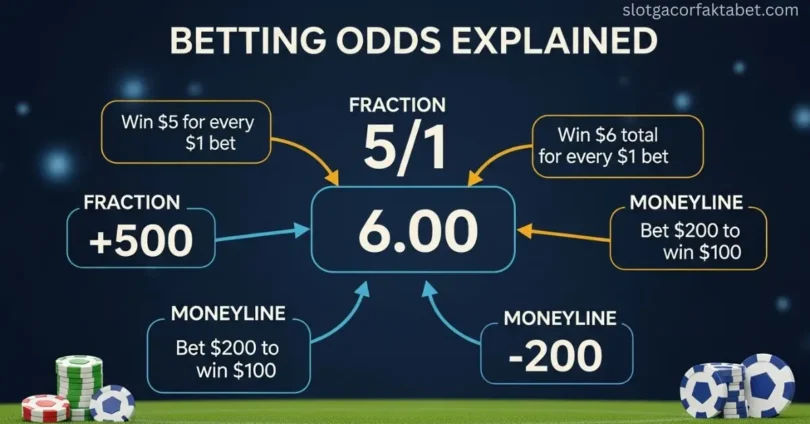
Betting Odds Explained is the first step to becoming a smart bettor. Betting odds show you how likely an event is to happen and how much money you can win if your bet is correct. They might look confusing at first, but once you know the basics, reading and using odds becomes simple.
What Are Betting Odds?
Betting odds are a way to show how likely an event is to happen and how much money you can win if you bet correctly.
- Odds tell you the probability of an outcome in a simple number format.
- They also show the potential profit you can make from your bet.
- Odds can be presented in different types: decimal, fractional, or American (moneyline).
- Higher odds usually mean the event is less likely but offers bigger winnings.
- Lower odds mean the outcome is more likely but gives smaller profits.
- Odds help bettors decide which bets are worth taking.
betting odds are a simple guide to probability and potential winnings, helping you make better choices when placing bets.
Types of Betting Odds
Betting odds come in different formats, and understanding each type helps you read and use them correctly.
- Decimal Odds:
- Show your total return including your stake.
- Example: Odds of 2.50 mean if you bet $10, you get $25 back ($15 profit).
- Fractional Odds:
- Show your profit relative to your stake.
- Example: Odds of 5/1 mean for every $1 you bet, you can win $5 profit.
- Often used in the UK and horse racing.
- American (Moneyline) Odds:
- Positive (+) shows how much profit you make on $100 bet.
Understanding different types of odds makes betting simpler and helps you calculate potential winnings with confidence.
How Betting Odds Reflect Probability
Betting odds not only show potential winnings but also indicate how likely an event is to happen.
- Understanding Probability:
- Probability shows the chance of an outcome happening, usually in percentage.
- Decimal Odds to Probability:
- Formula: Probability (%) = (1 ÷ Decimal Odds) × 100
- Example: Decimal odds 2.00 → (1 ÷ 2.00) × 100 = 50% chance
- Fractional Odds to Probability:
- Formula: Probability (%) = Denominator ÷ (Denominator + Numerator) × 100
- Example: 3/1 odds → 1 ÷ (3+1) × 100 = 25% chance
Betting odds reflect probability, helping you measure the chance of winning and make smarter bets.
How to Read Betting Odds
Reading betting odds correctly helps you understand your chances and potential winnings before placing a bet.
- Look at the Format:
- Check if the odds are Decimal, Fractional, or American.
- Each format shows the same idea in a slightly different way.
- Decimal Odds:
- Total return including your stake.
- Example: 3.00 odds → $10 bet returns $30 (profit $20).
- Fractional Odds:
- Shows profit relative to your stake.
- Example: 4/1 odds → $1 bet wins $4 profit.
Reading odds correctly is the key to understanding risk, reward, and making smart betting choices.
How to Convert Odds to Winnings
Knowing how to convert odds into potential winnings helps you understand exactly how much money you can make from a bet.
- Decimal Odds:
- Formula: Winnings = Bet × Decimal Odds
- Example: $10 bet at 2.50 → 10 × 2.50 = $25 total return ($15 profit).
- Fractional Odds:
- Formula: Profit = Bet × (Numerator ÷ Denominator)
- Example: $10 bet at 5/1 → 10 × (5 ÷ 1) = $50 profit ($60 total return including stake).
- American (Moneyline) Odds:
- Positive (+) Odds: Profit = Bet × (Odds ÷ 100)
- Example: $50 bet at +150 → 50 × (150 ÷ 100) = $75 profit
Converting odds to winnings lets you see the real value of your bet and plan smarter bets confidently.
Factors That Affect Betting Odds
Several factors influence betting odds, and knowing them can help you understand why odds change.
- Team or Player Performance:
- Recent form, past results, and current skill levels affect odds.
- Injuries and Absences:
- Key players missing a game can shift the odds significantly.
- Popularity and Public Betting Trends:
- High public bets on a team can make bookmakers adjust odds to balance risk.
- Statistics and Data:
- Historical stats, head-to-head records, and match conditions influence odds.
Understanding these factors helps you interpret odds better and make more informed betting decisions.
Common Mistakes When Reading Odds
Many beginners make simple mistakes when reading betting odds, which can lead to losses.
- Ignoring Bookmaker Margins:
- Not accounting for the small profit built into odds can mislead you about real chances.
- Confusing Probability with Potential Payout:
- High payout does not mean high probability; low payout does not mean guaranteed win.
- Only Betting on Favorites:
- Betting only on favorites can limit profits and ignore value bets.
- Not Comparing Odds:
- Different bookmakers offer different odds; failing to compare can cost potential winnings.
Avoiding these common mistakes helps you read odds correctly and make smarter, more profitable bets.
Future of Betting Odds Explained
The future of betting odds is changing with technology, data, and new trends, making betting smarter and more accurate.
- Use of Advanced Data Analytics:
- Bookmakers are using big data to set more precise odds based on player stats, team performance, and trends.
- Artificial Intelligence (AI) Integration:
- AI algorithms can predict outcomes faster and adjust odds dynamically during events.
- Live and In-Play Betting Growth:
- Odds are now changing in real-time as games progress, giving bettors more opportunities.
The future of betting odds is smarter, faster, and more data-driven, helping bettors make informed decisions with real-time insights.
Common FAQs about Betting Odds Explained
Some FAQs of Betting Odds Explained
What do betting odds really mean?
Betting odds show the chance of an event happening and how much money you can win if your bet is correct.
Are higher odds better than lower odds?
Higher odds give bigger potential profits but usually mean the outcome is less likely.
Can odds change after I place a bet?
No, once your bet is placed, your odds are locked. Odds can change only for new bets.
Why do different websites show different odds for the same event?
Each bookmaker calculates odds using their own data, statistics, and market trends.
What is the difference between implied probability and actual probability?
Implied probability comes from odds, while actual probability considers real-world factors like player performance and conditions.
Do betting odds affect my betting strategy?
Yes, understanding odds helps you choose value bets and manage your risk better.
Can I make consistent profit using odds alone?
Not always; odds show probability, but smart betting requires research, strategy, and money management.
Are decimal odds easier to use than fractional or American odds?
Many beginners find decimal odds simpler because they directly show total returns including stake.
What is a value bet in simple terms?
A value bet is when the odds suggest a lower chance than the real probability, giving a better potential profit.
Can technology help me understand odds better?
Yes, apps and software can calculate winnings, convert odds, and even track changes in real-time.
Conclusion
Betting odds are more than just numbers; they are a guide to making informed decisions and understanding the dynamics of any game or event. By learning to read odds, spotting trends, and using insights from statistics and technology, bettors can improve their approach and reduce unnecessary risks. The key is to combine knowledge with careful planning, keeping discipline and strategy at the center of every bet. With practice, odds can become a powerful tool to make smarter, more calculated betting choices.